> ## Documentation Index
> Fetch the complete documentation index at: https://agency-swarm.ai/llms.txt
> Use this file to discover all available pages before exploring further.
# Agency Context
> Sharing data and state across tools and agents using agency context.
`Agency Context` is a centralized data store accessible by all tools and agents within an agency. It allows you to share data between agents, control execution flow, and maintain state across tool calls without passing large data structures in messages.
Agency context is available when tools are deployed together with agents. If tools are deployed as separate APIs, they won't share the same context, and you'll need to implement your own state management solution.
## Understanding Agency Context
Agency context is particularly useful when your agents interact with multiple tools that need to exchange information. Here's why:
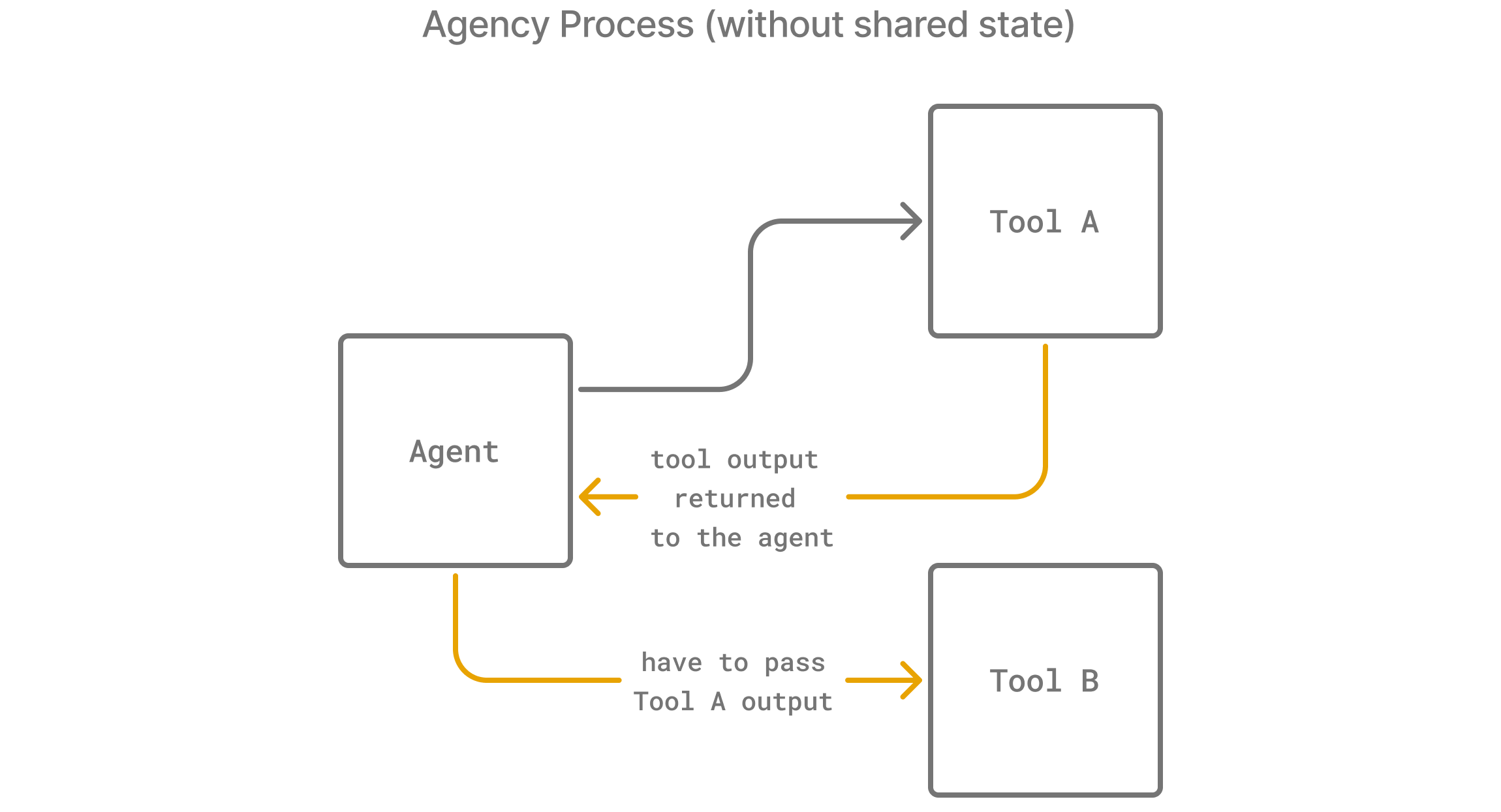
* **Without Agency Context**: Suppose `Tool A` collects data that `Tool B` needs. The agent must explicitly pass this data as a parameter to `Tool B`, consuming tokens and potentially hitting message limits.
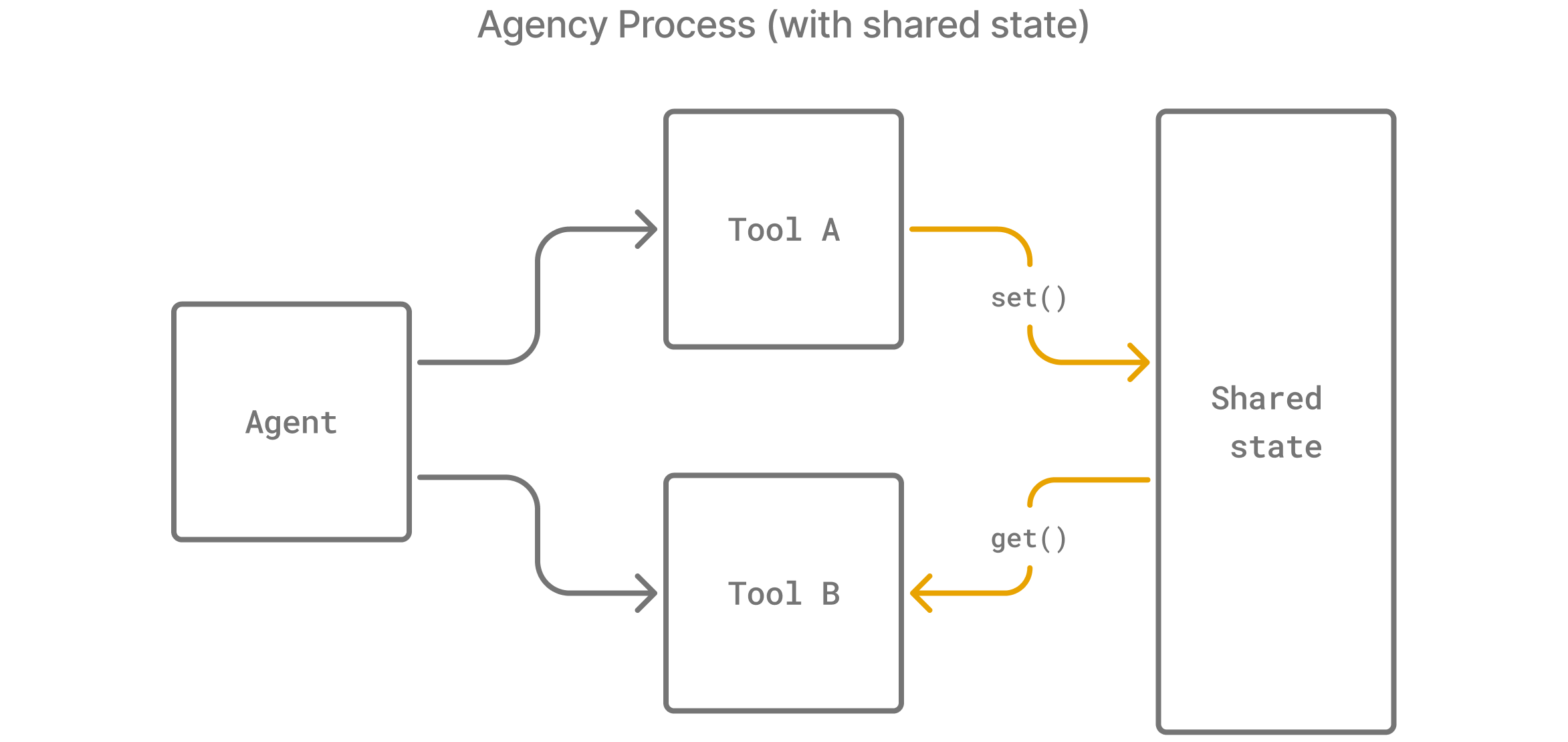
 * **With Agency Context**: `Tool A` can store the required data in the agency context, and `Tool B` can retrieve it without needing direct parameter passing. This approach reduces complexity, saves tokens, and enables additional workflows.
 ## Using Agency Context
The agency context is accessible in both FunctionTools and BaseTools using `.get` and `.set`, which let you access and modify the MasterContext passed during execution.
Below is an example of how it can be used across tools.
In this example, calling the Query Database tool stores database context, which is later retrieved by the Answer Question tool.
For BaseTools, access the agency context using `self.context`.
```python theme={null}
from agency_swarm.tools import BaseTool
from pydantic import Field
class QueryDatabase(BaseTool):
"""
Retrieves data from the database and stores it in the agency context.
"""
question: str = Field(..., description="The query to execute.")
async def run(self):
# Fetch data based on the question
context = query_database_api(self.question)
# Store the context in the agency context
assert self.context is not None
self.context.set('database_context', context)
self.context.set('last_query', self.question)
return "Database context has been retrieved and stored successfully."
class AnswerQuestion(BaseTool):
"""
Provides answers based on the context stored in the agency context.
"""
async def run(self):
# Access the stored context
assert self.context is not None
context = self.context.get('database_context')
if not context:
return "Database context is missing. Please call the query_database tool first."
# Generate an answer using the context
answer = f"Answer derived from context: {context}"
return answer
```
For FunctionTools, access the context using the following methods:
* **Setting** a value: `ctx.context.set('key', value)`
* **Getting** a value: `ctx.context.get('key', default_value)`
```python theme={null}
from agency_swarm import MasterContext, RunContextWrapper, function_tool
@function_tool
async def query_database(ctx: RunContextWrapper[MasterContext], question: str) -> str:
"""
Retrieves data from the database and stores it in the agency context.
"""
# Fetch data based on the question
context = query_database_api(question)
# Store the context in the agency context
ctx.context.set('database_context', context)
ctx.context.set('last_query', question)
return "Database context has been retrieved and stored successfully."
@function_tool
async def answer_question(ctx: RunContextWrapper[MasterContext]) -> str:
"""
Provides answers based on the context stored in the agency context.
"""
# Access the stored context
context = ctx.context.get('database_context')
if not context:
return "Database context is missing. Please call the query_database tool first."
# Generate an answer using the context
answer = f"Answer derived from context: {context}"
return answer
```
## Advanced Agency Context Patterns
### Complex Data Structures
Agency context can store any Python object, making it perfect for complex workflows:
```python theme={null}
@function_tool
async def analyze_market_data(ctx: RunContextWrapper[MasterContext], symbols: str) -> str:
"""Analyzes multiple stocks and stores data."""
symbol_list = symbols.split(',')
market_analysis = {
'timestamp': datetime.now().isoformat(),
'symbols': {},
'summary': {},
'analyst': ctx.context.current_agent_name
}
for symbol in symbol_list:
# Simulate market data fetch
market_analysis['symbols'][symbol] = {
'price': 150.0,
'volume': 1000000,
'trend': 'bullish'
}
# Store in agency context
ctx.context.set('market_analysis', market_analysis)
ctx.context.set('analysis_complete', True)
return f"Market analysis complete for {len(symbol_list)} symbols"
```
### Workflow Coordination
Use agency context to coordinate multi-step workflows:
```python theme={null}
@function_tool
async def step_1_data_collection(ctx: RunContextWrapper[MasterContext], params: str) -> str:
"""First step in a multi-step workflow."""
# Perform step 1
result = collect_data(params)
# Store progress in agency context
ctx.context.set('workflow_step_1', result)
ctx.context.set('workflow_status', 'step_1_complete')
return "Step 1 complete. Ready for step 2."
@function_tool
async def step_2_data_processing(ctx: RunContextWrapper[MasterContext]) -> str:
"""Second step that depends on first step."""
# Check if step 1 is complete
if ctx.context.get('workflow_status') != 'step_1_complete':
return "Error: Step 1 must be completed first"
# Get data from step 1
step_1_data = ctx.context.get('workflow_step_1')
# Process the data
result = process_data(step_1_data)
# Update progress
ctx.context.set('workflow_step_2', result)
ctx.context.set('workflow_status', 'step_2_complete')
return "Step 2 complete. Workflow finished."
```
### Session Management
Agency context is perfect for maintaining session state:
```python theme={null}
# Initialize agency with session context
agency = Agency(
entry_agent,
communication_flows=[(entry_agent, worker_agent)],
user_context={
'session_id': 'user_123',
'user_preferences': {
'language': 'en',
'timezone': 'UTC',
'risk_tolerance': 'moderate'
},
'session_start': datetime.now().isoformat()
}
)
```
## Best Practices
### Use Descriptive Keys
Use clear, descriptive keys to avoid conflicts between different agents and workflows:
```python theme={null}
# Good: Descriptive keys
ctx.context.set('user_portfolio_analysis_2024', data)
ctx.context.set('market_data_AAPL_realtime', market_data)
# Avoid: Generic keys that might conflict
ctx.context.set('data', data)
ctx.context.set('result', result)
```
### Provide Default Values
Always provide sensible defaults when retrieving data:
```python theme={null}
# Good: Provides default
user_prefs = ctx.context.get('user_preferences', {})
risk_level = ctx.context.get('risk_tolerance', 'moderate')
# Risky: No default, might return None
risk_level = ctx.context.get('risk_tolerance')
```
### Clean Up Unneeded Data
For long-running sessions, clean up temporary data to avoid memory issues:
```python theme={null}
@function_tool
async def cleanup_temporary_data(ctx: RunContextWrapper[MasterContext]) -> str:
"""Cleans up temporary analysis data."""
temp_keys = ['temp_calculation_1', 'temp_calculation_2', 'scratch_data']
for key in temp_keys:
if key in ctx.context.user_context:
del ctx.context.user_context[key]
return "Temporary data cleaned up successfully"
```
## Migrating tools
If you're migrating from Agency Swarm v0.x, and want to use new FunctionTool instead of BaseTool, here's how you can do that:
**BaseTool Pattern:**
```python theme={null}
class MyTool(BaseTool):
async def run(self):
assert self.context is not None
self.context.set("key", "value")
data = self.context.get("key", "default")
return "Done"
```
**FunctionTool Pattern:**
```python theme={null}
@function_tool
async def my_tool(ctx: RunContextWrapper[MasterContext], param: str) -> str:
"""Updated tool using agency context."""
ctx.context.set("key", "value")
data = ctx.context.get("key", "default")
return "Done"
```
## Example: Complete Workflow
For a full example showing agency context in action, see the [Agency Context Workflow Example](https://github.com/VRSEN/agency-swarm/blob/main/examples/agency_context.py) which demonstrates:
* Multi-step data collection and analysis
* Cross-agent data sharing
* Session management
* Workflow coordination
* Context monitoring and debugging
Agency context eliminates the need for complex parameter passing and enables multi-agent workflows while maintaining clean separation of concerns.
## Using Agency Context
The agency context is accessible in both FunctionTools and BaseTools using `.get` and `.set`, which let you access and modify the MasterContext passed during execution.
Below is an example of how it can be used across tools.
In this example, calling the Query Database tool stores database context, which is later retrieved by the Answer Question tool.
For BaseTools, access the agency context using `self.context`.
```python theme={null}
from agency_swarm.tools import BaseTool
from pydantic import Field
class QueryDatabase(BaseTool):
"""
Retrieves data from the database and stores it in the agency context.
"""
question: str = Field(..., description="The query to execute.")
async def run(self):
# Fetch data based on the question
context = query_database_api(self.question)
# Store the context in the agency context
assert self.context is not None
self.context.set('database_context', context)
self.context.set('last_query', self.question)
return "Database context has been retrieved and stored successfully."
class AnswerQuestion(BaseTool):
"""
Provides answers based on the context stored in the agency context.
"""
async def run(self):
# Access the stored context
assert self.context is not None
context = self.context.get('database_context')
if not context:
return "Database context is missing. Please call the query_database tool first."
# Generate an answer using the context
answer = f"Answer derived from context: {context}"
return answer
```
For FunctionTools, access the context using the following methods:
* **Setting** a value: `ctx.context.set('key', value)`
* **Getting** a value: `ctx.context.get('key', default_value)`
```python theme={null}
from agency_swarm import MasterContext, RunContextWrapper, function_tool
@function_tool
async def query_database(ctx: RunContextWrapper[MasterContext], question: str) -> str:
"""
Retrieves data from the database and stores it in the agency context.
"""
# Fetch data based on the question
context = query_database_api(question)
# Store the context in the agency context
ctx.context.set('database_context', context)
ctx.context.set('last_query', question)
return "Database context has been retrieved and stored successfully."
@function_tool
async def answer_question(ctx: RunContextWrapper[MasterContext]) -> str:
"""
Provides answers based on the context stored in the agency context.
"""
# Access the stored context
context = ctx.context.get('database_context')
if not context:
return "Database context is missing. Please call the query_database tool first."
# Generate an answer using the context
answer = f"Answer derived from context: {context}"
return answer
```
## Advanced Agency Context Patterns
### Complex Data Structures
Agency context can store any Python object, making it perfect for complex workflows:
```python theme={null}
@function_tool
async def analyze_market_data(ctx: RunContextWrapper[MasterContext], symbols: str) -> str:
"""Analyzes multiple stocks and stores data."""
symbol_list = symbols.split(',')
market_analysis = {
'timestamp': datetime.now().isoformat(),
'symbols': {},
'summary': {},
'analyst': ctx.context.current_agent_name
}
for symbol in symbol_list:
# Simulate market data fetch
market_analysis['symbols'][symbol] = {
'price': 150.0,
'volume': 1000000,
'trend': 'bullish'
}
# Store in agency context
ctx.context.set('market_analysis', market_analysis)
ctx.context.set('analysis_complete', True)
return f"Market analysis complete for {len(symbol_list)} symbols"
```
### Workflow Coordination
Use agency context to coordinate multi-step workflows:
```python theme={null}
@function_tool
async def step_1_data_collection(ctx: RunContextWrapper[MasterContext], params: str) -> str:
"""First step in a multi-step workflow."""
# Perform step 1
result = collect_data(params)
# Store progress in agency context
ctx.context.set('workflow_step_1', result)
ctx.context.set('workflow_status', 'step_1_complete')
return "Step 1 complete. Ready for step 2."
@function_tool
async def step_2_data_processing(ctx: RunContextWrapper[MasterContext]) -> str:
"""Second step that depends on first step."""
# Check if step 1 is complete
if ctx.context.get('workflow_status') != 'step_1_complete':
return "Error: Step 1 must be completed first"
# Get data from step 1
step_1_data = ctx.context.get('workflow_step_1')
# Process the data
result = process_data(step_1_data)
# Update progress
ctx.context.set('workflow_step_2', result)
ctx.context.set('workflow_status', 'step_2_complete')
return "Step 2 complete. Workflow finished."
```
### Session Management
Agency context is perfect for maintaining session state:
```python theme={null}
# Initialize agency with session context
agency = Agency(
entry_agent,
communication_flows=[(entry_agent, worker_agent)],
user_context={
'session_id': 'user_123',
'user_preferences': {
'language': 'en',
'timezone': 'UTC',
'risk_tolerance': 'moderate'
},
'session_start': datetime.now().isoformat()
}
)
```
## Best Practices
### Use Descriptive Keys
Use clear, descriptive keys to avoid conflicts between different agents and workflows:
```python theme={null}
# Good: Descriptive keys
ctx.context.set('user_portfolio_analysis_2024', data)
ctx.context.set('market_data_AAPL_realtime', market_data)
# Avoid: Generic keys that might conflict
ctx.context.set('data', data)
ctx.context.set('result', result)
```
### Provide Default Values
Always provide sensible defaults when retrieving data:
```python theme={null}
# Good: Provides default
user_prefs = ctx.context.get('user_preferences', {})
risk_level = ctx.context.get('risk_tolerance', 'moderate')
# Risky: No default, might return None
risk_level = ctx.context.get('risk_tolerance')
```
### Clean Up Unneeded Data
For long-running sessions, clean up temporary data to avoid memory issues:
```python theme={null}
@function_tool
async def cleanup_temporary_data(ctx: RunContextWrapper[MasterContext]) -> str:
"""Cleans up temporary analysis data."""
temp_keys = ['temp_calculation_1', 'temp_calculation_2', 'scratch_data']
for key in temp_keys:
if key in ctx.context.user_context:
del ctx.context.user_context[key]
return "Temporary data cleaned up successfully"
```
## Migrating tools
If you're migrating from Agency Swarm v0.x, and want to use new FunctionTool instead of BaseTool, here's how you can do that:
**BaseTool Pattern:**
```python theme={null}
class MyTool(BaseTool):
async def run(self):
assert self.context is not None
self.context.set("key", "value")
data = self.context.get("key", "default")
return "Done"
```
**FunctionTool Pattern:**
```python theme={null}
@function_tool
async def my_tool(ctx: RunContextWrapper[MasterContext], param: str) -> str:
"""Updated tool using agency context."""
ctx.context.set("key", "value")
data = ctx.context.get("key", "default")
return "Done"
```
## Example: Complete Workflow
For a full example showing agency context in action, see the [Agency Context Workflow Example](https://github.com/VRSEN/agency-swarm/blob/main/examples/agency_context.py) which demonstrates:
* Multi-step data collection and analysis
* Cross-agent data sharing
* Session management
* Workflow coordination
* Context monitoring and debugging
Agency context eliminates the need for complex parameter passing and enables multi-agent workflows while maintaining clean separation of concerns.